


Gambia Erupts: Power Crisis Sends Thousands Into the Streets as Anger Turns Against Barrow
Share your love
By Pa Modou Cham
BANJUL, The Gambia — The Gambia was plunged into a night of anger, fire and confrontation on Monday as thousands of residents poured onto the streets across the Greater Banjul Area and parts of the West Coast Region, protesting prolonged electricity blackouts that have increasingly become a source of public frustration.
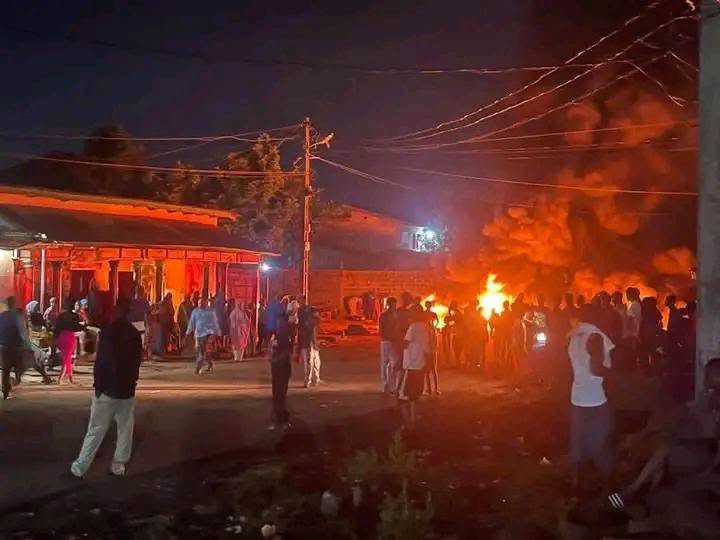
What began in Banjul around 9 p.m. as a candle-lit demonstration led by Banjul North National Assembly Member Hon. Modou Lamin Bah rapidly spread into a much larger, spontaneous wave of protests, with residents in several communities taking to the streets, burning tyres and blocking major roads.
By late Monday night and into the early hours of Tuesday, scenes of unrest were reported in Westfield, Tallinding, Latrikunda Sabiji, Wellingara, Sunchu, Brikama, Brusubi Turntable, Bakoteh, Busumbala, Farato, Fajikunda and several other communities.
The scale and speed of the protests exposed the depth of public anger over a power crisis that has persisted for months and, according to residents, has become a recurring feature of daily life.
In some areas, protesters confronted security forces, while police used tear gas to disperse crowds. Protesters burned tyres and erected barricades in and around Banjul, with some chanting “Barrow must go!”
From candlelight protest to street confrontation
The protest in Banjul initially carried the character of a peaceful candlelight demonstration.
Residents emerged into the darkness carrying candles and mobile phones, demanding that the National Water and Electricity Company (NAWEC) restore electricity.
Chants of “Bring back power, we are tired of the darkness” and “Banjulians deserve better” reportedly echoed through the capital.
But the mood quickly changed as the demonstrations spread.
Large crowds gathered around major junctions and roads in the Kombos, with burning tyres sending thick smoke into the night sky. In Westfield, protesters moved towards NAWEC facilities, prompting the deployment of anti-riot police and the use of tear gas.
The confrontation was not confined to Westfield.
In Farato, protesters reportedly gathered near the residence of Vice President Mohammed B.S. Jallow and damaged ruling-party banners. Reports also indicated damage to NAWEC facilities in Latrikunda and disturbances around the Farato Police Station.
The night became a stark illustration of how quickly frustration over a basic public service can transform into a wider political protest.
“There is no light everywhere”
For many protesters, Monday night was not simply about one blackout. It was about years of frustration. Households have complained about food spoiling, businesses losing income, students struggling to study, salons and tailoring businesses being unable to operate, and families enduring long, hot nights without electricity.
At Westfield, resident Ousainou Jammeh told Reuters that the absence of electricity had become unbearable. “There is no light everywhere. There is no light. People have been crying about electricity.”
Jammeh said he joined the protest after tear gas reached his house. After the demonstrations subsided before dawn, he joined other young men in helping to extinguish fires and clear barricades from the streets.
Alieu Jallow, a resident of Latrikunda Sabiji told this medium that the blackout has significantly disrupted their business while, noting that most of the government officials are enjoying free electricity. ‘They don’t care about us but come December they will know that power belongs to the people’.
In a Live Video, a young people from Brikama, Busumbala and Wellingara were heard expressing their frustration. They called on the government to fix the electricity problem or take the street again.
A group of women confronted the NAWEC Sub-Station in Wellingara to express their frustration. One of them said, ‘for how long are we going to live with this frustration and endure the hardship? They either fix the problem or we show them how to fix it on December 5th.’
A crisis that has been building
Monday night’s explosion of public anger did not come out of nowhere. The electricity crisis has been building for months, with Gambians repeatedly complaining about lengthy and unpredictable outages.
NAWEC has attributed the latest shortages to a combination of factors, including rising electricity demand, fuel challenges and constraints affecting the wider power system. The utility has also previously warned that technical problems and increased consumption could require load shedding in several parts of the country.
In August, NAWEC warned of an unforeseen increase in electricity demand during peak periods, which it attributed partly to high temperatures, as well as a technical incident affecting a major generating unit on the import side. The utility said the situation would require load shedding in several parts of the country.
But for residents who have spent repeated nights without electricity, explanations are becoming increasingly difficult to accept. For them, the central question is simple: When will the lights stay on?
Power crisis becomes political crisis
The protests also carried a clear political message. With the country heading towards presidential elections on 5 December 2026, public anger over electricity is now emerging as a potentially significant political issue.
The Independent Electoral Commission has officially scheduled the presidential election for December 5, with the campaign period set to begin in November.
President Adama Barrow is seeking a third term, and the opposition has already begun positioning itself for the election.
For some protesters, the electricity crisis is no longer merely a service-delivery failure, it is becoming a referendum on the government’s performance.
Political chants directed at President Barrow were heard during the protests, including calls for him to leave office. Protesters shouted “Barrow must go!” as tyres burned and barricades went up in the streets.
The anger raises a difficult question for the government: Can the electricity crisis be contained before it becomes an electoral crisis?
Government under mounting pressure
The timing could hardly be more politically sensitive. The government is preparing for a presidential election less than three months away, while the electricity crisis is affecting households, businesses and public services.
President Barrow was scheduled to visit NAWEC facilities on Tuesday and address the nation later in the evening following the overnight unrest. The president’s response could therefore prove crucial.
A promise of additional generation capacity or emergency measures may calm the immediate anger, but many protesters appear to be demanding something deeper: reliable electricity, accountability and a permanent solution to the country’s power problems.
A night that changed the conversation
By Tuesday morning, the fires had largely been extinguished and traffic had begun returning to normal in Banjul. Some young people were seen clearing debris and removing barricades from the roads. But the political and social consequences of the night’s events may last considerably longer.
What began as residents carrying candles into the streets became a nationwide expression of frustration, with thousands demonstrating across communities that rarely mobilise simultaneously. The message from the streets was unmistakable:
Gambians are tired of living in darkness.
And with the December 5 presidential election approaching, the question now confronting President Barrow and his government is whether the anger over electricity will fade with the restoration of power, or whether Monday night’s protests have opened a much bigger political chapter.
For a government seeking another mandate, the lights may need to come back on quickly.
Because for many Gambians, the electricity crisis is no longer just about darkness. It is about trust, livelihoods, governance, and the future of the country.