



Bertil Harding Highway Phase III Reaches Major Milestone as Construction Progresses
Share your love
Banjul, The Gambia – The National Roads Authority (NRA) has announced significant progress on the Bertil Harding Highway Phase III Project, with construction advancing across key sections of one of the country’s busiest road corridors.
The project, which builds on the successful completion of Phases I and II, is designed to improve traffic flow, strengthen road safety, enhance drainage systems, and expand accessibility through the construction of new service roads, the Sukuta/Jabang Overpass, and other supporting infrastructure.
According to the NRA, the development forms part of the Government’s Recovery-Focused National Development Plan (RF-NDP) and the National Transport Policy (2018–2027), while contributing to the long-term improvement of the country’s road infrastructure.
Construction Progress
The contractor, AREZKI, has fully mobilised its workforce, with construction activities currently underway along multiple sections of the highway. Interim supervision of the project has been provided by GAMWORKS while the procurement process for a permanent supervision consultant was being finalised.
Utility Relocation Nearing Completion
The Authority reported that major utility relocation works have been substantially completed, paving the way for uninterrupted civil works.
Completed relocation works include NAWEC electricity and water services, as well as GAMTEL infrastructure between the Sukuta/Jabang Overpass and Palma Rima Roundabout. Utility relocation around the Brusubi Roundabout and Independence Stadium roads has also been completed, while GAMTEL ducting and pipe installation have been finalised, with cable installation now in its final stages.
Civil Works Advancing
Significant progress has also been recorded on the construction of service roads and supporting infrastructure.
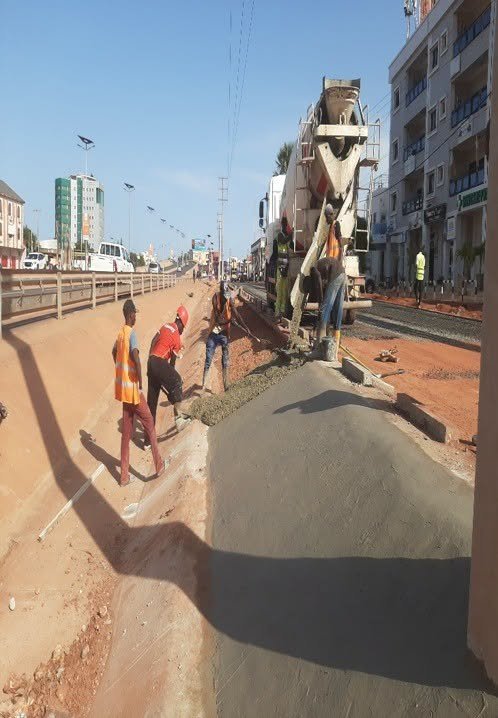
Drainage systems, subgrade, subbase, base course and asphalt surfacing have been completed on several sections of the project. Roads serving the Independence Stadium and Sports Centre have been fully completed, including carriageways, parking areas, sidewalks, kerbs and double surface dressing.
Between Sukuta/Jabang and Palma Rima, earthworks, pavement construction and concrete-lined drainage channels are substantially complete, while kerbs, sidewalks and pavement blocks have been installed across large sections of the Senegambia corridor. Preparatory activities, including site clearing, earthworks and stockpiling of construction materials, continue on the remaining sections.
Sukuta/Jabang Overpass 84% Complete
The landmark Sukuta/Jabang Overpass has reached approximately 84 percent completion.
The NRA said major structural works, including piling, pile caps, piers, cross beams, deck slab casting, post-tensioning and grouting, have all been completed. Successful pile integrity tests have also been carried out.
Construction of embankments for the approach ramps is nearing completion, while installation of precast panels and cornices has reached approximately 95 percent. Traffic diversion routes around the overpass have also been completed to allow construction to continue safely.
Engineering and Supervision
Engineering design and project supervision have also progressed significantly.
Approved designs now cover the Independence Stadium roads, Sukuta/Jabang Overpass, service roads, retaining walls, approach ramps, drainage infrastructure and road geometry across several sections of the project. The consultant has also approved utility relocation plans and the alignment for new service roads between Brusubi and Palma Rima.
Expected Benefits
Upon completion, the Bertil Harding Highway Phase III Project is expected to transform mobility within the Greater Banjul Area by easing congestion, improving road safety, addressing persistent drainage challenges and enhancing access to residential communities, commercial centres and tourism destinations.
The project is also expected to stimulate economic activity, facilitate trade and investment, and strengthen the resilience of The Gambia’s transport network.