

Billions for NAWEC, Darkness for Gambians: Inside the D2.6 Billion Bailout That Didn’t End the Blackouts
Share your love
By Pa Modou Cham
BANJUL – As thousands of Gambians endured recurring power cuts, prolonged water shortages and rising business losses throughout 2025, the government quietly poured more than D2.59 billion into the National Water and Electricity Company (NAWEC) in what has become one of the largest public interventions to rescue a state-owned enterprise in recent years.
The disclosure, contained in the 2025 Aggregate Financial Performance Report of State-Owned Enterprises (SOEs), raises fresh questions about the effectiveness of public spending on the country’s sole electricity and water provider at a time when frustration over poor service delivery has reached unprecedented levels.
The report shows that government support to NAWEC came in two major forms.
The first was D1.12 billion in electricity tariff compensation, intended to ensure affordable electricity while advancing the government’s goal of universal energy access. The second was an unplanned D1.47 billion bailout to settle outstanding arrears owed to Turkish floating power producer Karpower following the expiration of its contract in May 2025. Together, the two interventions totaled D2.59 billion in taxpayer support.
The financial injection transformed NAWEC’s books almost overnight.
After recording a staggering D3.12 billion loss in 2024, the utility posted a D1.33 billion profit in 2025, representing one of the most dramatic financial reversals among all state-owned enterprises.
According to the report, the turnaround was largely driven by the government bailout, stronger electricity and water bill collections, increased cash power sales through third-party vendors and significantly lower foreign exchange losses after replacing the costly Karpower arrangement with hydroelectric energy imported from Senegal’s EDG network. Revenue also climbed by 18 percent, reaching D9.93 billion during the year.
On paper, the figures present a remarkable success story. But beyond the balance sheet lies a very different reality.
Throughout the year, households across The Gambia continued to experience prolonged electricity outages, erratic water supply and repeated service interruptions. Businesses reported losing productive hours because of unreliable electricity, while many resorted to generators, significantly increasing operating costs.
Small businesses, restaurants, welding workshops, internet cafés, cold stores and manufacturing firms have repeatedly identified unstable electricity as one of the biggest constraints to productivity and profitability.
The crisis eventually spilled into the streets.
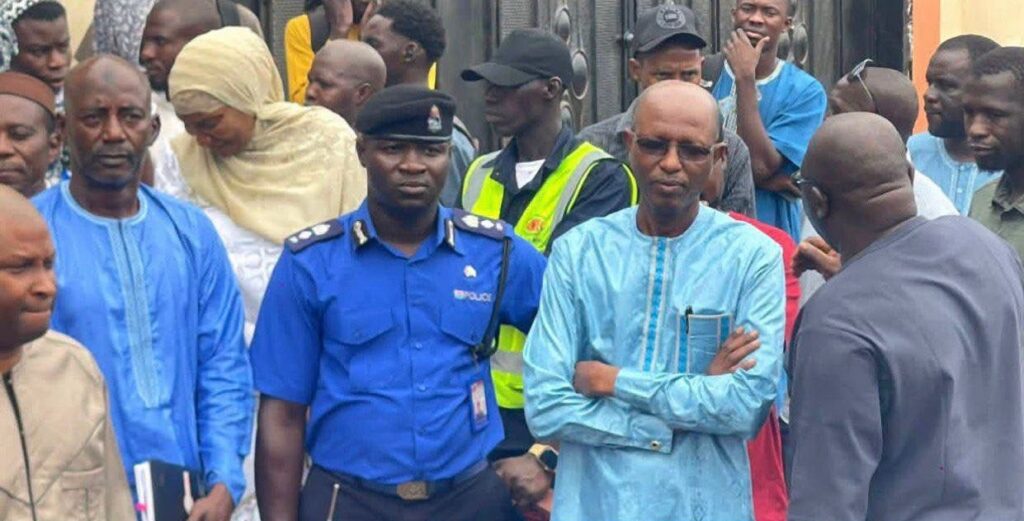
In recent weeks, members of Gambians Against Looted Assets (GALA) staged demonstrations outside NAWEC headquarters, demanding immediate improvements in electricity and water services. Protesters accused the utility of failing to provide reliable public services despite receiving substantial government support over the years.
The release of the SOE report is likely to intensify those concerns.
While NAWEC reported a return to profitability, the report also exposes the enormous financial burden still weighing on the company.
Its total liabilities climbed to D19.07 billion, compared with assets worth D14.07 billion, leaving the utility with a negative equity position of nearly D5 billion. In simple terms, the company still owes significantly more than it owns.
That imbalance suggests the reported profit does not necessarily reflect a financially healthy enterprise.
Instead, much of the improvement appears to stem from extraordinary government intervention rather than fundamental operational transformation.
The report itself acknowledges that the government’s bailout was the primary reason NAWEC moved from heavy losses into profitability.
The Karpower settlement also marks the end of an expensive chapter in The Gambia’s electricity sector.
For years, the government relied on the Turkish power ship to supplement domestic electricity generation, but the arrangement exposed NAWEC to substantial foreign exchange risks because payments were denominated in US dollars. The depreciation of the dalasi significantly increased the utility’s operating costs, contributing to recurring losses.
Government officials argue that replacing Karpower with imported hydroelectricity from Senegal’s Organisation pour la Mise en Valeur du fleuve Gambie (OMVG)-linked network through EDG will reduce generation costs over the long term.
The report suggests those savings have already begun to materialize through lower foreign exchange losses. However, financial improvements have yet to translate into consistently reliable service delivery.
This disconnect between improved financial statements and continued public dissatisfaction raises broader questions about the performance of state-owned enterprises.
Should profitability be considered the primary measure of success for a public utility?
For consumers, uninterrupted electricity, clean running water and dependable customer service often matter far more than accounting profits.
The report also reveals the extent to which government finances remain exposed to NAWEC’s fortunes.
Beyond the D2.59 billion provided in direct support during 2025, the company continues to represent the single largest financial risk within the state’s enterprise portfolio because of its massive liabilities and continued dependence on government intervention.
Economists have long argued that repeated bailouts can stabilize essential public utilities in the short term but may also weaken incentives for deeper institutional reforms if underlying operational inefficiencies remain unresolved.
The challenge facing policymakers is therefore twofold: maintaining affordable electricity while building a financially sustainable utility capable of investing in infrastructure without relying on recurring taxpayer rescues.
The report provides encouraging signs that revenue collection has improved and operating costs have declined following the Karpower exit. Yet it also demonstrates that NAWEC remains heavily indebted and structurally vulnerable despite recording its first major profit in years.
For many Gambians, the question is no longer whether NAWEC can produce positive financial statements.
It is whether billions of dalasis in public support will finally deliver what citizens have demanded for years, stable electricity, reliable water supply and an end to the blackouts that continue to disrupt homes, hospitals, schools and businesses across the country.
As public pressure mounts and expectations grow, the utility’s next challenge will not simply be protecting its newfound profitability. It will be proving that financial recovery can be matched by tangible improvements in the lives of the people it was created to serve.