Breaking News






By Pa Modou Cham
The growing number of fatal road accidents across The Gambia has once again thrust road safety into the national spotlight, with authorities, transport operators and industry stakeholders warning that unless urgent reforms are implemented, more lives will continue to be lost on the country’s highways.
The latest tragedy occurred on the night of Wednesday, July 8, 2026, when three people died and three others sustained injuries after two vehicles and a motorcycle collided at Jiffin in the Lower River Region. The injured victims, one of whom remains in critical condition, are receiving treatment at Soma District Hospital while police continue investigations into the circumstances surrounding the crash.
The accident came barely days after another devastating tragedy outside the country’s borders, where seven passengers travelling from The Gambia to Sierra Leone lost their lives after their commercial vehicle collided with a fuel tanker in Guinea. Thirteen others suffered serious injuries in what has become one of the deadliest road crashes involving Gambian travellers this year.
These incidents are only the latest in a disturbing string of road tragedies that have occurred throughout 2026, from the January highway collision between Farafenni and Bereto that killed seven people, to fatal motorcycle crashes in the Upper River Region and multiple serious accidents in Foni.
For many Gambians, the question is no longer whether another fatal accident will occur, but when.
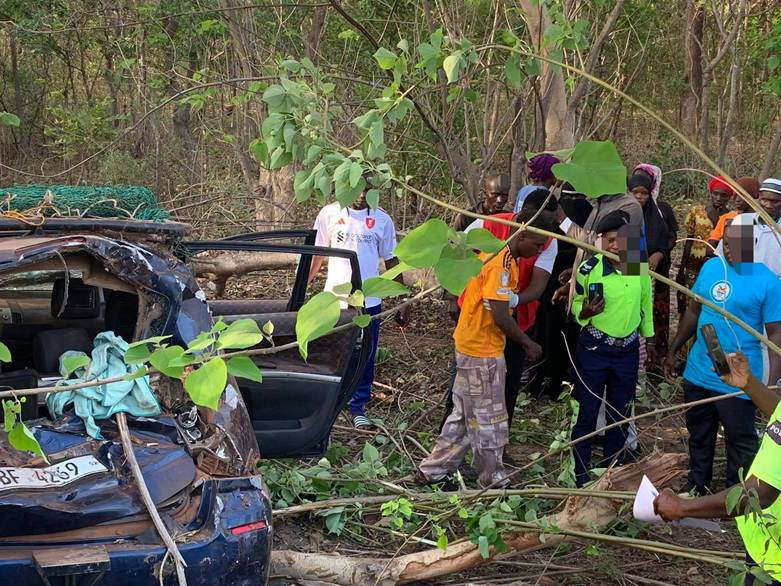
June 27, 2026 Road Accident in Tampoto (Foni)
Police: “Every Fatal Crash Is One Too Many”
The Gambia Police Force admits that road traffic accidents remain one of the country’s most pressing public safety concerns.
Speaking to CTV Africa, Police Public Relations Officer Assistant Superintendent Modou Musa Sisawo said investigations consistently identify excessive speed, dangerous overtaking, driver negligence, fatigue, vehicle defects and disregard for traffic regulations as the principal causes of serious crashes.
“Every fatal crash is one too many,” Sisawo said, noting that police continuously analyse accident trends to guide enforcement and prevention strategies.
According to him, the Traffic Unit has intensified visibility patrols, speed enforcement operations, routine checkpoints and compliance inspections nationwide.
Police are also cracking down on offences including dangerous driving, overloading, illegal parking, unregistered vehicles, drink-driving where applicable, and other violations under the Motor Traffic Act.
Yet Sisawo acknowledged that enforcement alone cannot eliminate road accidents.
“Drivers themselves must make responsible decisions every time they get behind the wheel,” he stressed.
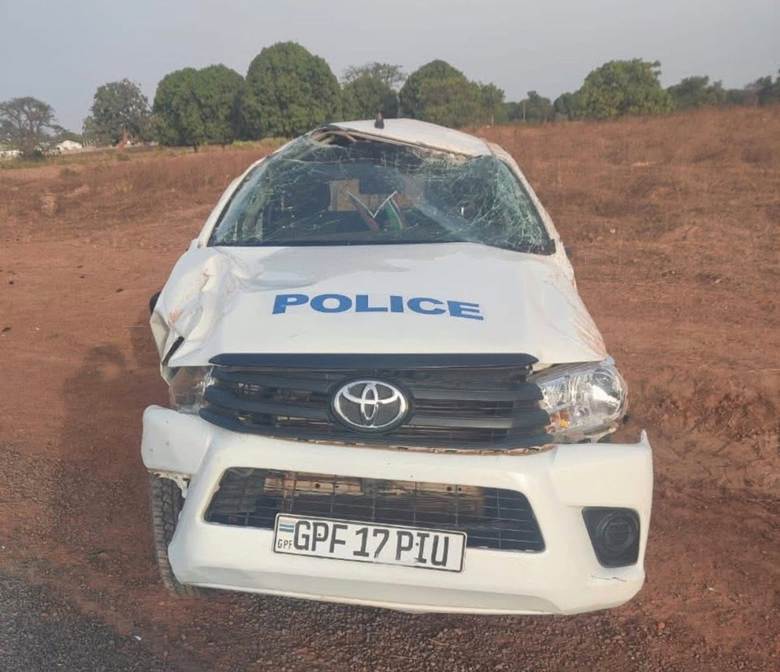
Police Vehicle involved in an accident killing Constable Lamin Badjie of Kerewan PIU in May 2026 on the Jammeh Kunda–Salikenni highway
Resource Constraints Hamper Enforcement
Despite increasing police presence on the roads, questions continue to be raised by members of the public over inconsistent enforcement of traffic laws.
Sisawo acknowledged those concerns but said policing road safety is becoming increasingly challenging.
“The Gambia Police Force has significantly intensified traffic enforcement across the country, but like many policing agencies, we operate within resource and logistical constraints, including increasing traffic volumes and limited personnel relative to demand.”
Nevertheless, he said intelligence-led deployments and targeted operations continue in high-risk accident zones while encouraging citizens to report dangerous driving behaviour.
Transport Union Calls for Major Reforms
The General Transport Union (GTU) believes solving the country’s road safety crisis requires far more than police enforcement.
GTU President Omar Ceesay argues that the country’s entire road safety framework needs to be overhauled. Among the Union’s biggest concerns is the driver licensing system.
According to Ceesay, every applicant should undergo rigorous theoretical examinations, practical driving tests, vision screening and medical assessments before obtaining a licence.
He also points to poor road engineering as a major contributor to crashes. “There are gaps in road design and safety infrastructure,” he noted.
“We need improved road engineering standards, proper road signs, road markings and safety measures that meet internationally accepted standards.”
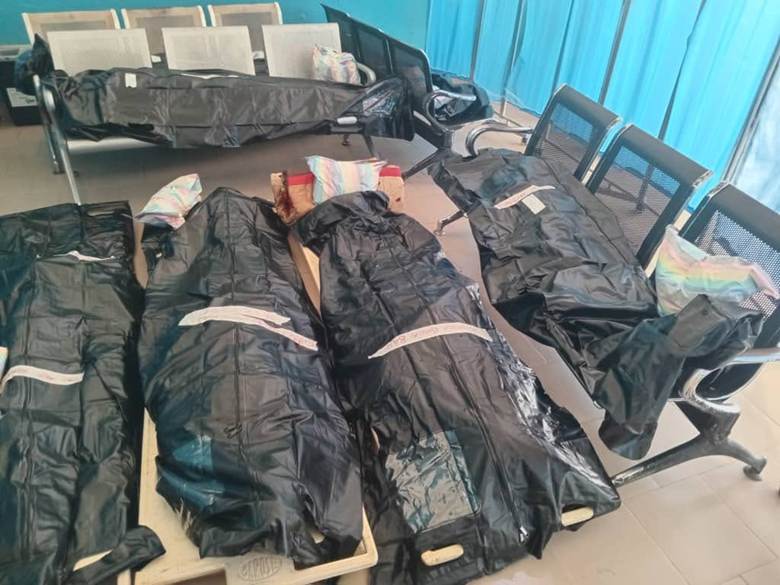
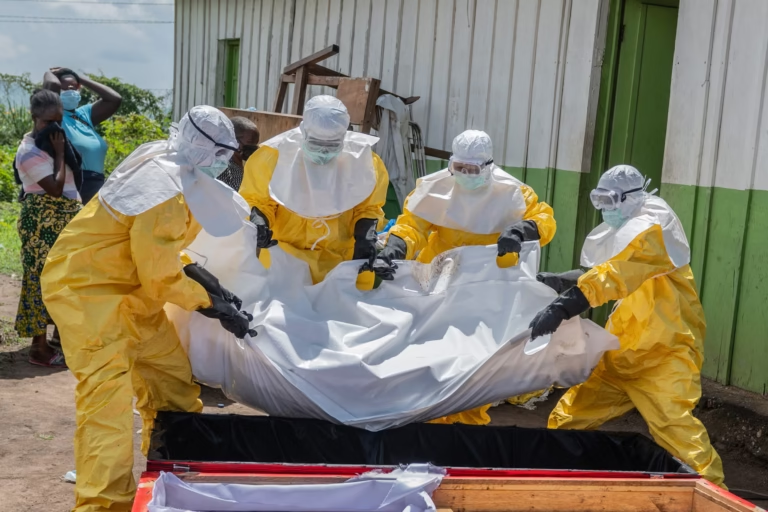
Bodies of a fatal road traffic accident on Saturday, June 21, 2026, at YBK in the Central River Region
Speeding, Fatigue and Poor Training
While speeding frequently dominates discussions following fatal accidents, the GTU says several interconnected factors are responsible.
According to Ceesay, dangerous overtaking, poor understanding of the Highway Code and inadequate driver education continue to place passengers at risk. He believes many commercial drivers have not received sufficient defensive driving training.
“We must strengthen driver education and enforcement if we want to significantly reduce accidents.”
Driver fatigue also remains a persistent concern, particularly among operators covering long-distance regional routes between The Gambia and neighbouring countries.
The Union is advocating for designated highway rest areas, improved driver scheduling and regular health assessments to ensure drivers remain fit before embarking on long journeys.
Transport Operators Under Pressure
Commercial transport operators have increasingly come under public scrutiny following several fatal crashes involving passenger vehicles.
However, transport companies insist they are strengthening internal safety standards.
Aji Ndey Cham, Founder and Proprietress of Sunu Transit, said her company has adopted strict safety measures including enforcing speed limits, banning mobile phone use while driving and requiring seatbelt use where applicable.
Drivers undergo refresher training in road safety, defensive driving and customer service, while their performance is regularly monitored.
“Our goal is to create a culture where safety always comes before profit or meeting schedules,” she said.
Cham explained that vehicles undergo scheduled maintenance by qualified mechanics and are subjected to daily safety inspections before leaving the depot.
Any vehicle found with mechanical defects is immediately withdrawn from service until repairs are completed.
Infrastructure Remains a Critical Challenge
Beyond driver behaviour, stakeholders say inadequate infrastructure continues to expose motorists to unnecessary danger.
The GTU is calling for major investments in road expansion, particularly upgrading sections such as the South Bank Road into dual carriageways where feasible.
The Union also wants better lighting, road shoulders, parking bays, road markings and modern traffic management systems.
These improvements, it argues, would dramatically reduce collision risks while improving traffic flow nationwide.
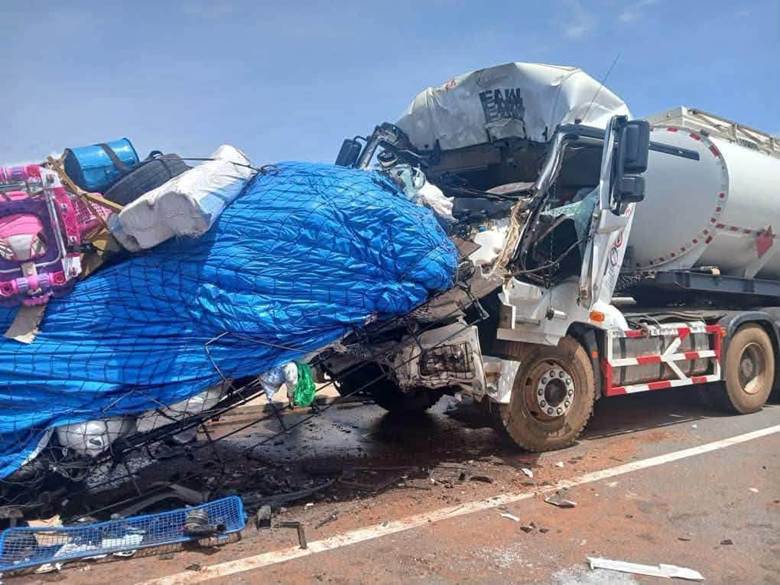
Seven Killed, 13 Injured in Tragic Cross-Border Crash Involving Gambian Passenger Vehicle on 9 July 2026
A Shared Responsibility
Despite differing perspectives, all stakeholders interviewed agreed on one central message: road safety cannot be achieved by police alone.
The Police say stronger partnerships with government institutions, transport unions, schools, local authorities, civil society organisations, the media and ordinary citizens are essential.
They are also advocating greater investment in road infrastructure, improved vehicle inspection systems, enhanced driver education and technology-driven traffic management.
Similarly, the GTU has recommended the creation of a dedicated national road safety agency, stronger traffic law enforcement, stricter vehicle inspections, improved public awareness campaigns and ensuring that only roadworthy vehicles are allowed on Gambian roads.
A National Emergency
The succession of fatal crashes witnessed throughout 2026 paints a troubling picture.
Lives have been lost on highways, in villages and across international routes. Police officers, schoolchildren, commercial drivers and ordinary passengers have all become victims.
Behind every statistic is a grieving family, shattered livelihoods and communities left searching for answers.
While police continue to intensify enforcement and transport operators pledge stronger safety standards, experts say meaningful change will require sustained political commitment, better infrastructure, stricter regulation and, above all, a culture in which every road user accepts personal responsibility.
Until then, The Gambia’s roads will continue to serve as a painful reminder that every journey carries a risk, and every preventable accident is one too many.
The Gambia National Road Authority were reached for comments but to no avail.