Breaking News

Popular News



By Pa Modou Cham
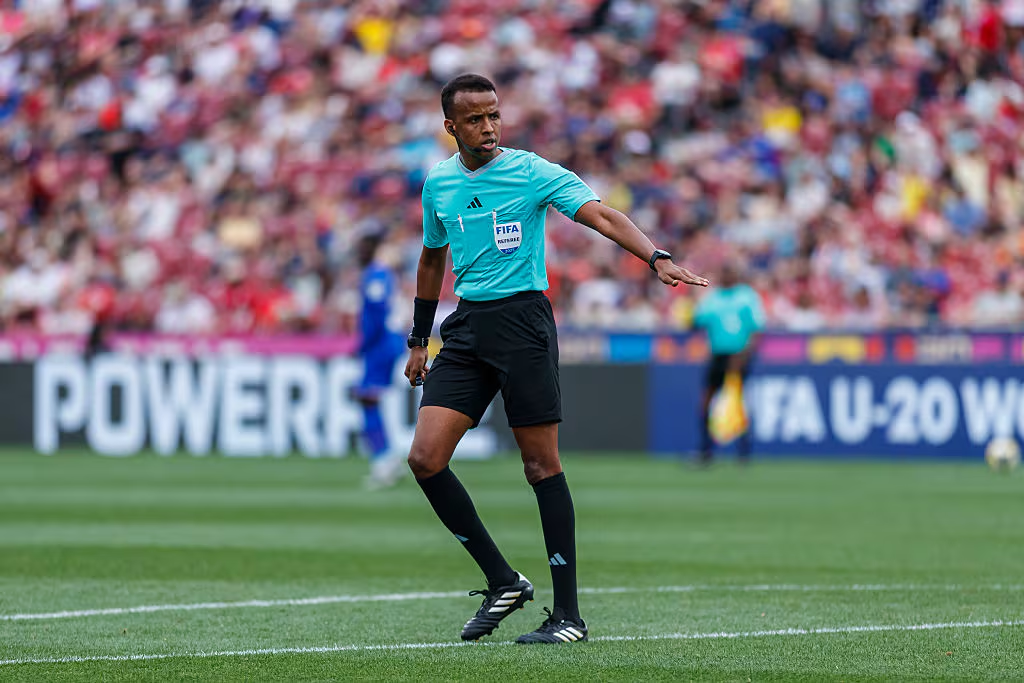
What should have been the crowning moment of Omar Abdulkadir Artan’s refereeing career has instead turned into one of the most controversial stories of the 2026 FIFA World Cup.
The Somali official, named Africa’s Best Referee in 2025, will not officiate at the World Cup after being denied entry into the United States, ending his dream of becoming the first Somali referee to take charge of a match at football’s biggest tournament.
Artan was among the 52 match officials selected by FIFA for the expanded 2026 World Cup, a recognition of years of dedication and excellence on the continent and beyond. Having officiated at major African competitions, including the Africa Cup of Nations and CAF Champions League matches, his appointment was celebrated across Somalia and Africa as a landmark achievement.
However, the historic moment was abruptly cut short when Artan arrived at Miami International Airport from Istanbul and was denied entry by U.S. authorities. Despite reportedly holding valid travel documents, he was declared inadmissible following what officials described as “vetting concerns.” FIFA later confirmed that he would be unable to participate in the tournament.
The decision has sparked widespread disappointment across Somalia and the wider football community, with many viewing it as a devastating blow to a referee who had earned his place on merit.
For Somalia, Artan’s selection had represented more than a personal achievement. It was a symbol of progress for a nation striving to rebuild its sporting reputation on the global stage. President Hassan Sheikh Mohamud had previously praised the referee as an inspiration to young Somalis, highlighting his professionalism and dedication as an example for future generations.
Speaking after the setback, Artan remained composed despite the disappointment.
“Despite the circumstances, I am in a positive mood and I am focused on the next challenges in my refereeing career,” he said after learning he would miss the tournament.
FIFA confirmed that it had no authority over immigration decisions made by host nations and stated that Artan’s status would not be changed in time for the competition.
The controversy has also reignited debate over travel restrictions and visa policies affecting participants at international sporting events. Critics argue that global tournaments such as the World Cup should guarantee access for qualified players, officials and staff regardless of nationality, while supporters of stricter immigration measures maintain that host nations have the right to conduct security vetting.
For Artan, the missed opportunity is particularly painful. At 34, he stood on the verge of making history not only for himself but for an entire nation. Instead of taking charge of matches before millions of viewers around the world, he found himself returning home to Mogadishu, where supporters welcomed him as a hero despite the disappointment.
While the 2026 World Cup will proceed without him, Omar Artan’s story has become one of the tournament’s earliest and most talked-about controversies—a reminder that even in the world’s most celebrated sporting event, politics and borders can sometimes overshadow sporting achievement.
For many across Africa, the question remains: how does one of the continent’s most accomplished referees earn a place at the World Cup, only to be denied the chance to step onto its stage?